 Español
  English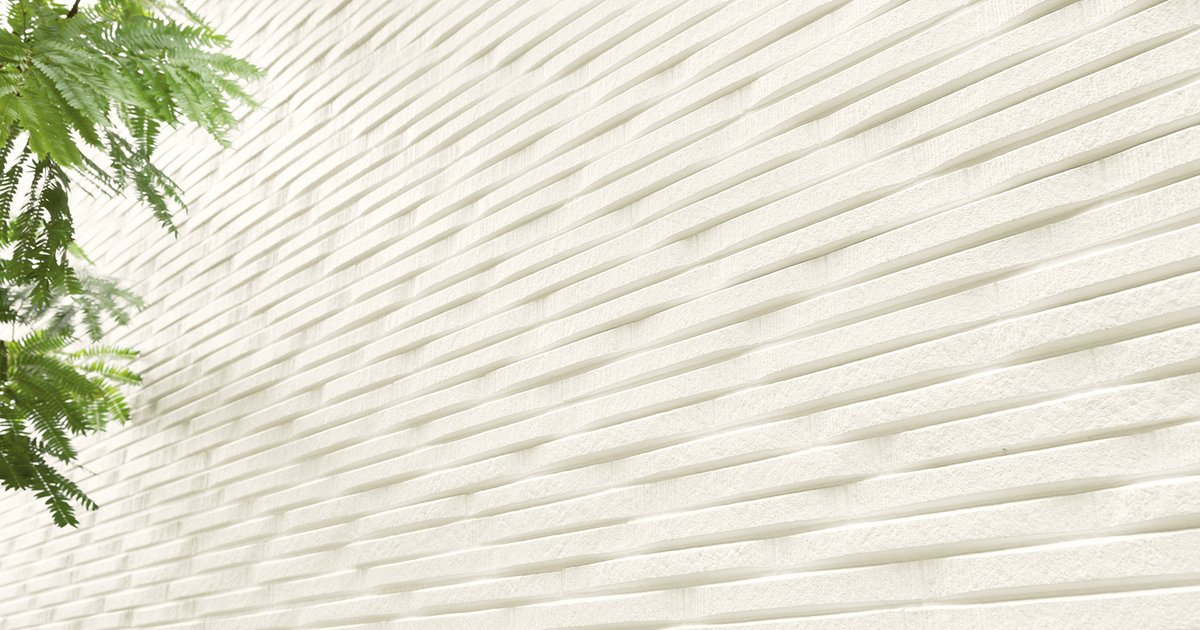
KMEW and aluminium composite panels (ACP or ACM) can both form part of ventilated facade systems, but they follow very different product logics. KMEW is a pre-finished facade panel with relief and its own fixing geometry; ACP is a light, very flat composite sheet that can be cut, routed and folded to create trays or cassettes specific to each project.
That is why the comparison should not be limited to price per m². Weight, fabrication before installation, fixing system, reaction to fire, format, texture, thermal expansion and maintenance have a direct influence on the final solution.
1. Comparison at a glance
| Criterion | KMEW | ACP / ACM | What it means for the project |
|---|---|---|---|
| Cladding weight | Ceradir V: approx. 14.7 kg/m². Filltect 16 mm: approx. 18.1 kg/m², according to commercially available references. | ALUCOBOND A2 / PLUS example: 5.9 kg/m² at 3 mm and 7.6 kg/m² at 4 mm. | A clear ACP advantage in weight. |
| Format | 3000/3030 × 455 mm; a long, narrow piece. | Large widths and lengths; ALUCOBOND reaches up to 6800 mm in length, depending on the range. | ACP reduces joints and offers large format. |
| Product / fabrication | A factory-finished panel; installed with KMEW accessories and clips. | The panel can be used flat or turned into a cassette by cutting, routing, folding and machining. | KMEW reduces project-specific fabrication; ACP offers far greater formability. |
| Concealed fixing | Clips built into the panel logic; face fixing only where the manual requires it. | Possible with cassette/hook systems or other concealed systems, but it usually depends on the detailing of each solution. | Both can achieve a clean facade. |
| Texture | Deep 3D reliefs: wood, brick, stone, stucco, Stripe. | An essentially smooth surface, with metallic, solid and anodised finishes, effects and printed designs; it can also be formed three-dimensionally. | KMEW: material depth. ACP: flatness, folding and colour. |
| Colour / graphics | A wide palette tied to textures and reliefs. | A very wide palette of colours, metallics, Spectra, naturAL, Design and custom finishes. | ACP is particularly strong in colour and metallic effects. |
| Fire | Check the exact classification of the current KMEW reference/ETA. | Depends on the core: for example, ALUCOBOND A2 = A2-s1,d0; ALUCOBOND PLUS = B-s1,d0. | Never treat ACP as a single fire category when comparing. |
| Surface / dirt | Filltect: photocatalytic ceramic coating. Ceradir V: hydrophilic coating. | Weather-resistant coil-coated polymer coatings, according to the manufacturer; maintenance depends on the finish and exposure. | Different surface technologies. |
| Complex geometry | Relief built into the face, but a modular panel format. | Excellent for folds, trays, corners, copings, curves and special shapes. | ACP wins on geometric freedom. |
2. Weight: here ACP has an objective advantage
Aluminium composite panels are significantly lighter. For reference, ALUCOBOND A2 and ALUCOBOND PLUS declare 5.9 kg/m² for 3 mm and 7.6 kg/m² for 4 mm. The KMEW references commonly used by Japan Facades sit at approximately 14.7 kg/m² for Ceradir V and 18.1 kg/m² for Filltect 16 mm.
So if the main criterion is to minimise the load of the cladding on the subframe or on an existing building, ACP deserves serious consideration. It would not be professional to try to turn weight into a KMEW advantage over composite.
| Reference | Thickness | Weight | Format / sheet | Weight per piece |
|---|---|---|---|---|
| KMEW Ceradir V | 14 mm | ≈ 14.7 kg/m² | 3000 × 455 mm | ≈ 20 kg / panel |
| KMEW Filltect | 16 mm | ≈ 18.1 kg/m² | 3030 × 455 mm | ≈ 25 kg / panel |
| ALUCOBOND A2 / PLUS | 3 mm | 5.9 kg/m² | widths up to 1500/1750 mm depending on type | depends on the cutting plan |
| ALUCOBOND A2 / PLUS | 4 mm | 7.6 kg/m² | length up to 6800 mm depending on the range | depends on the cutting plan |
3. Finished product versus transformable material
This is probably the most important conceptual difference. KMEW arrives as a finished facade panel, with defined colour, relief and installation geometry. ACP arrives as an extremely versatile composite sheet that can be turned into multiple geometries by cutting, routing and folding.
| KMEW | ACP |
|---|---|
| Panel system. The modulation, the panel edge and the accessories form a repetitive logic. The project selects a reference, defines the cutting plan and junctions, and carries out the installation. Less transformation of the cladding. | Raw material for cassettes. The architect can define large trays, returns, corners, folds, copings and very free geometries. To achieve this, the sheet has to be machined according to the shop drawings. More freedom of form. |
| Advantage. It reduces the reliance on fabricating each piece as a specific tray when the design fits the KMEW modulation. Industrialisation through the product. | Advantage. It makes it possible to accommodate unique geometries with a flat material that is cut and folded practically to measure. Industrialisation through fabrication. |
4. Cassette fabrication: an operation that has to be accounted for
In ACP cassette solutions, the work does not end with buying the sheet. The process may include the cutting plan, CNC cutting, routing grooves on the reverse side, folding, stiffeners, return profiles and suspension elements. 3A Composites explicitly describes the routing and folding method: a groove is machined on the reverse side, leaving part of the core and the front aluminium skin, which allows the panel to be folded.
This capability is a major advantage of ACP, but it also means that cost and lead time have to be analysed as “sheet + transformation + cassette + fixing system”, not simply as the price of the sheet.
5. Concealed fixing: not exclusive to KMEW
Both KMEW and ACP can produce facades with no visible fixings across the main facade field. The difference lies in how this is achieved.
| Solution | How it is achieved | Result | Implication |
|---|---|---|---|
| KMEW | Dedicated clips and accessories work with the panel geometry. | Concealed across the main field; face screws only in situations defined by the manual. | A repetitive system tied to the product. |
| ACP cassette | The folded tray is fixed or hung on profiles, hooks or systems specific to the subframe manufacturer. | Can be fully concealed. | Requires a cassette and engineering detailing. |
| ACP with visible fixing | Visible rivets or screws on a flat sheet. | Very efficient and light, but the fixing remains visible. | A valid solution where the aesthetics allow it. |
6. Reaction to fire: the ACP core changes the comparison completely
“Aluminium composite panel” is not a fire classification. There are products with very different cores and performance. For example, ALUCOBOND A2 declares class A2-s1,d0 according to EN 13501-1, while ALUCOBOND PLUS declares B-s1,d0.
A serious comparison must therefore identify the exact ACP product and its core. With KMEW, too, the reaction-to-fire classification corresponding to the reference and to the current technical documentation/ETA must be verified before it is included in a contractual specification.
| Material | What it is | What to check |
|---|---|---|
| KMEW | A fibre-cement panel; KMEW Europe publishes specific ETAs for Filltect and Ceradir V14. | Verify the exact classification of the current reference/ETA. |
| ACP A2 — ALUCOBOND A2 example | A mineral core with a binder; product declared A2-s1,d0. | Suitable for high reaction-to-fire requirements, depending on the project and regulations. |
| ACP FR — ALUCOBOND PLUS example | A mineral-filled polymer core; product declared B-s1,d0. | Must not be confused with an A2 version. |
| ACP with a PE or other core | Performance varies by product. | Do not accept the generic term “ACP” without a technical data sheet. |
7. Texture and architecture: two very different languages
The aesthetic difference between KMEW and ACP is not that one has “more finishes” than the other. Both offer enormous possibilities, but of a different nature.
| KMEW | ACP |
|---|---|
| Real relief. The surface is moulded with depth. Wood, brick, stone, stucco or linear patterns create physical shadows and a material reading that changes with the light. Volume and materiality. | Flatness and precision. Its great strength is a very flat, continuous surface: solids, metallics, anodised finishes, effects, special colours and printed designs. Purity and continuity. |
| An integrated finish. Colour and texture come defined as a complete factory reference. Choose a reference. | Design through transformation. The sheet can be folded, curved or formed into cassettes. Volume is created through the geometry of the element, not mainly through surface relief. Design the element. |
8. Colour: ACP offers exceptional freedom
Leading ACP systems offer very wide ranges of solid, metallic and anodised colours, iridescent effects and designer finishes. ALUCOBOND, for example, presents the Solid, Metallic, Urban, Terra, naturAL, Anodized Look, Spectra, Sparkling, Rocca, Artenara and Design families, as well as colours made to order.
KMEW works differently: colour is tied to the profile and the relief, so the combination of geometry, shadow and tone forms a complete architectural reference.
9. Thermal expansion and joints
In aluminium composite panels, thermal expansion is part of the facade detailing. ALUCOBOND publishes a coefficient of linear expansion of 2.4 mm/m for a temperature difference of 100 K. This means cassette dimensions, joints and fixings must allow for the expected movements.
KMEW also requires modulation, gaps, fixings and junctions in accordance with its manual. It is not accurate to present either solution as “movement-free”; the difference lies in the nature of the material and the system by which those movements are controlled.
10. Surface, dirt and maintenance
| Solution | Technology / behaviour |
|---|---|
| Filltect | Photocatalytic ceramic coating: KMEW describes dirt being broken down by light and washed away by rain; it also highlights protection against colour loss from UV. |
| Ceradir V | Hydrophilic coating: rainwater gets underneath the dirt and makes it easier to remove. |
| ACP | Coil-coated polymer coatings; leading manufacturers highlight weather resistance. The cleaning strategy depends on the finish, the environment and the manufacturer’s recommendations. |
Neither material should be sold as “maintenance-free”. In both cases, the building needs inspection, cleaning where appropriate and a repair strategy suited to the exposure and the system.
11. Repair and localised damage
KMEW works panel by panel, and the European manual includes replacement procedures. With ACP, repair depends on whether it is a flat sheet or a cassette, and on how it is hung or fixed.
The type of damage also changes: a metal face can deform locally without breaking, while a rigid cementitious panel can be damaged differently by a severe impact. That is why universal claims along the lines of “one breaks and the other does not” are best avoided: what has to be compared is the real repairability of the installed system.
12. When might KMEW be the better choice?
- When the architecture seeks real three-dimensional relief and deep shadows.
- When a factory-finished reference is wanted, not a tray that has to be designed and fabricated for each piece.
- When concealed fixing with standard clips and accessories fits well with the project’s modulation.
- When the specific surface technologies of Filltect or Ceradir V are valued.
- When wood, brick, stone, stucco or linear patterns are central to the architectural language.
- When the repeatability of a 455 mm piece can simplify planning and installation.
13. When might ACP / ACM be the better choice?
- When minimum cladding weight is an essential priority.
- When very large pieces and few joints are needed.
- When the project requires folds, cassettes, returns, curves or special geometries.
- When a very flat, metallic or anodised surface, or a specific corporate colour, is needed.
- When the fabricator/installer has a well-optimised process chain for the design, CNC machining, folding and installation of cassettes.
- When the chosen ACP fire solution meets the project requirements exactly and provides the lightness required.
14. The right question is not “KMEW or aluminium”
The decision should start from the intent of the project. If the facade is imagined as a light, smooth, metallic, folded skin, ACP is a natural solution. If it is imagined as a surface with materiality, relief and the physical texture of stone, wood or brick, KMEW starts from a logic closer to that intent.
Weight, reaction to fire, fixing system, subframe, wind, fabrication, modulation, maintenance, lead time and the total cost of the solution must then be verified.
15. Summary table
| Criterion | KMEW | ACP / ACM | Typical advantage |
|---|---|---|---|
| Weight | ≈ 14.7–18.1 kg/m² | ≈ 5.9–7.6 kg/m² in 3–4 mm A2/PLUS examples | ACP |
| Concealed fixing | Clips integrated into the KMEW system | Available via a cassette/suspension system | Depends on the project |
| Fabrication before installation | Low / pre-finished panel | Medium-high for cassettes: cutting, routing, folding | KMEW |
| Large format | Fixed format, 455 mm high | Very high freedom of size | ACP |
| 3D surface | Deep factory relief | Mainly flat surface; volume through forming | KMEW |
| Metallic / corporate colour | Limited to the catalogue and references | Very wide / custom | ACP |
| Fire | Verify ETA/reference | Highly dependent on the core: A2, FR, others | See the exact product |
| Cleaning technology | Photocatalytic / hydrophilic, depending on the series | Coil coating + maintenance according to the finish | Different approaches |
| Formability | Limited by the panel and accessories | Excellent: routing, folding, curves, cassettes | ACP |
Technical sources
1. KMEW Europe — Optocera / Filltect — 3030 × 455 mm; 16/18 mm; Photocatalytic Ceramic Coating; rain cleaning; UV colour-fading protection: https://www.kmewglobal.com/europe/products/optocera/
2. KMEW Europe — Ceradir V — 3000 × 455 × 14 mm; Hydrophilic Coating; mid/high-rise positioning; rain cleaning; frost resistance: https://www.kmewglobal.com/europe/products/ceradirv/
3. KMEW Europe — Technical Information — ETA Filltect, ETA Ceradir V14, EPD and installation manuals: https://www.kmewglobal.com/europe/technical-information/
4. KMEW Europe — Aluminum Substructure Manual, Sep. 2025 — panel geometry, clips, horizontal/vertical application, accessories and repair procedures: https://www.kmewglobal.com/europe/assets/pdf/ceradir_v_filltect_tm_for_aluminum_frame_eu.pdf
5. ALUCOBOND A2 — 3A Composites — 3/4 mm; 5.9/7.6 kg/m²; A2-s1,d0; widths and lengths; colour/finish families; thermal expansion: https://www.alucobond.com/en/products/by-brand/alucobond-a2/
6. ALUCOBOND PLUS — 3A Composites — 3/4 mm; 5.9/7.6 kg/m²; mineral-filled polymer core; B-s1,d0: https://www.alucobond.com/en/products/by-brand/alucobond-plus/
7. ALUCOBOND Processing — routing and folding — reverse-side routing and folding process used to create formed elements/cassettes: https://www.alucobond.com/files/downloads/produkte/en/ALUCOBOND_balcony_Processing_instructions_EN.pdf
8. ALUCOBOND — At a glance — low weight, flatness, surfaces/colours, formability and recyclability; A2 vs PLUS distinction: https://www.alucobond.com/files/downloads/produkte/en/ALUCOBOND_At_a_glance_EN.pdf
Methodological note: the ACP values are given using ALUCOBOND, one of the internationally recognised manufacturers, as an example, and are not universal characteristics of all aluminium composite panels. On each project, the specific manufacturer, aluminium thickness, core type, coating, reaction-to-fire classification and fixing system must be verified.